
Dr. Christina Rieth

State Archaeologist and Co-Director, Cultural Resource Survey Program
christina.rieth@nysed.gov
518-402-5975

My research focuses on the ways that prehistoric groups interacted with their local environment and the role that such interaction had on the settlement and subsistence strategies of New York’s Late Prehistoric (A.D. 700-1450) occupants. The relationship between humans and their natural and cultural environment is of importance in understanding pre-Contact diversity. The choices that we make concerning the types of resources that are used, the interactions that we form with neighboring groups in acquiring these resources, and how we modify the local landscape all influence the resulting behaviors and material culture. Field and collections based research form the basis for addressing these issues. 

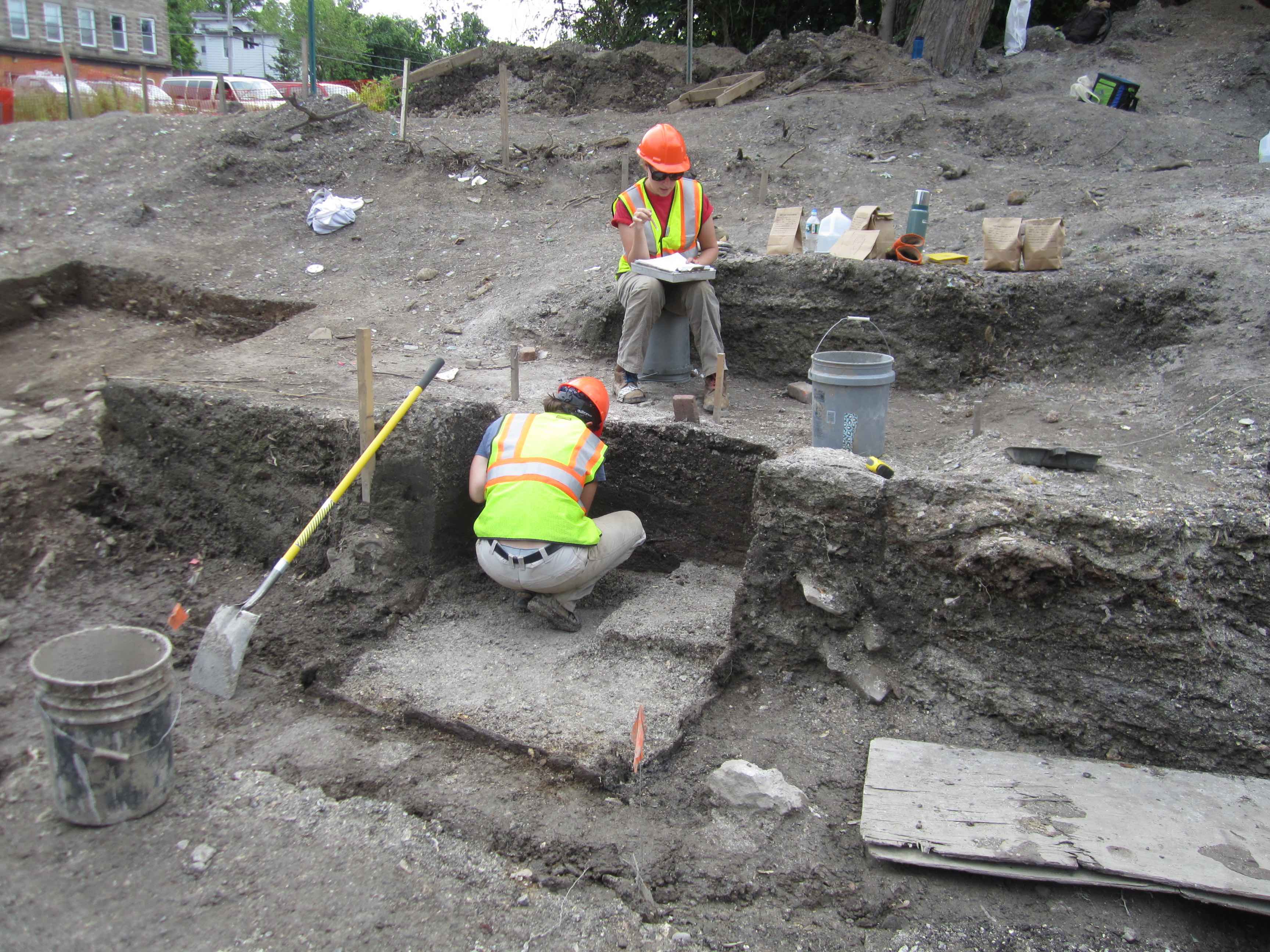
Finally, I am interested in public archaeology and the ways that archaeologists make information about and incorporate the public into its study of the past. Through an active program of field and collections based research, I am interested in making information about the archaeological past accessible to all New Yorkers.

Publications

2019

R. Feranec, J. Hart 2019, Fish and maize: Bayesian mixing models of fourteenth- through seventeenth-century AD ancestral Wendat diets, Ontario, Canada, Scientific Reports 9, 16658. 10.1038/s41598-019-53076-7
Larisa DeSantis, Jonathan Crites, R. Feranec, Kena Fox-Dobbs, Aisling Farrell, John Harris, Gary Takeuchi, Thure Cerling 2019, Causes and Consequences of Pleistocene Megafaunal Extinctions as Revealed from Rancho La Brea Mammals, Current Biology 29, 2488-2495. 10.1016/j.cub.2019.06.059

2018

Sarah Heins-Ledogar, R. Feranec, Jessica Zuhlke 2018, Isotopic evidence for broad diet including anadromous fish during the mid-Holocene in northeastern North America, Journal of Archaeological Science: Reports 19, 505-512. 10.1016/j.jasrep.2018.03.029
Wysocki, M., Feranec, R., 2018. Analyzing the Tooth Development of Sabertooth Carnivores: Implications Regarding the Ecology and Evolution of Smilodon fatalis, in: Werdelin, L., McDonald, H., Shaw, C. (Eds.), Smilodon: The Iconic Sabertooth. Johns Hopkins University Press, Baltimore, Maryland, pp. 139-152.
Kozlowski, A., Bird, B., Lowell, T., Smith, C., Feranec, R., Graham, B., 2018. Minimum Age of the Mapleton, Tully, and Labrador Hollow Moraines Indicates Correlation with the Port Huron Phase in Central New York State, in: , Quaternary Glaciation of the Great Lakes Region: Process, Landforms, Sediments, and Chronology. Geological Society of America, Boulder, Colorado, pp. 191–216.
Feranec, R., Kozlowski, A., 2018. Onset Age of Deglaciation Following the Last Glacial Maximum in New York State Based on Radiocarbon Ages of Mammalian Megafauna, in: Kehew, A., Curry, B. (Eds.), Quaternary Glaciation of the Great Lakes Region: Process, Landforms, Sediments, and Chronology. Geological Society of America, Boulder, Colorado, pp. .

2017

R. Feranec, A. Kozlowski 2017, Ice Age Mammals Colonize New York: A STEM Lab Derived from Collections-Based Research at the New York State Museum, New York State Museum Education Leaflet New York State Education Department, Albany, New York
L.C. Eastham, R. Feranec, D. Begun 2017, Trace Element Analysis Provides Insight into the Diets of Early Late Miocene Ungulates from the Rudab\ anya II Locality (Hungary), Geologica Acta 15, 231-243. 10.1344/GeologicaActa2017.15.3.6
R. Feranec, D. Pagnac 2017, Hypsodonty, horses, and the spread of C4 grasses during the middle Miocene in southern California, Evolutionary Ecology Research 18, 201–223.
R. Feranec, A. Kozlowski 2017, Ice Age Mammals Colonize New York: A STEM Lab Derived from Collections-Based Research at the New York State Museum, New York State Museum Education Leaflet New York State Education Department, Albany, New York