
Dr. Jeremy J. Kirchman

Curator of Birds and Mammals
jeremy.kirchman@nysed.gov
518-474-1441

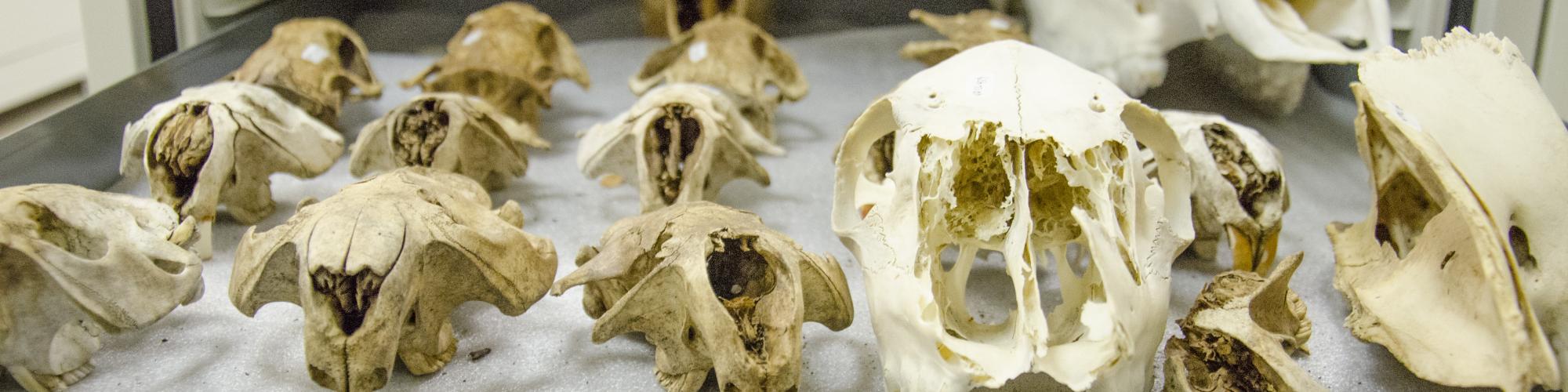
I am broadly interested in the evolution and biogeography of birds, but most of my research focuses on populations found on islands. Islands have long been considered “natural laboratories of evolution”, and studying birds on islands teaches us much about speciation, extinction, and adaptation.  I have a special interest in one group of birds, the rails (Rallidae), which are great island colonists, found even on the most remote oceanic islands.  Many rail species have evolved to become totally flightless on islands that lack mammalian predators. Closer to home, I am studying several species of birds that breed in “islands” of coniferous (boreal) forest isolated above 3000 feet of elevation in New York’s mountain ranges. I want to know if these populations of Bicknell’s Thrush, Yellow-bellied Flycatcher, Spruce Grouse and other boreal forest specialists are genetically isolated and evolving independently of one another. These high-elevation populations may be imperiled as the climate continues to warm.

Publications

2023

K. Mghazli, N. Lazreq, G. Geyer, E. Landing, M. Boumehdi, N. Youbi 2023, Cambrian microfossils from the High Atlas, Morocco: Taxonomic, biostratigraphic, palaeobiogeographic, and depositional significance of the Brèche \ a Micmacca limestone beds, Journal of African Earth Sciences 197, 104751. 10.1016/j.jafrearsci.2022.104751
E. Landing, B. Kroger, S. Westrop, G. Geyer 2023, Proposed Early Cambrian cephalopods are chimaeras, the oldest known cephalopods are 30 m.y. younger, Communications Biology 6, 32. 10.1038/s42003-022-04383-9

2022

J. Nguyen, S. Westrop, E. Landing 2022, The Cambrian (Furongian) olenid trilobite <i>Peltura</i> from Avalonian Nova Scotia, Canada, with a review of some species from Baltica, Canadian Journal of Earth Sciences , . 10.1139/cjes-2022-0007
E. Landing, S. Westrop, G. Geyer 2022, Trans-Avalonian green–black boundary (early Middle Cambrian): transform fault-driven epeirogeny and onset of 26 m.y. of shallow marine anoxia in Avalonia (Rhode Island–Belgium) and Baltica, Canadian Journal of Earth Sciences , . 10.1139/cjes-2022-0065
E. Landing, R. Ripperdan, G. Geyer 2022, Discussion of ‘Reply to “Uppermost Cambrian carbon chemostratigraphy: the HERB and undocumented TOCE events are not synonymous”’Abstract, Geological Magazine 159, 173-176. 10.1017/S001675682100090X
G. Geyer, E. Landing, S. Meier, S. Höhn 2022, Oldest known West Gondwanan graptolite: Ovetograptus? sp. (lower Agdzian/lowest Wuliuan; basal Middle Cambrian) of the Franconian Forest, Germany, and review of pre-Furongian graptolithoids, PalZ , . 10.1007/s12542-022-00627-5

2021

E. Landing, Gerd Geyer, Igor Jirkov, Stefano Schiaparelli, Julia Sigwart 2021, Lophotrochozoa in the Cambrian evolutionary radiation and the Pelagiella problem, Papers in Palaeontology , . 10.1002/spp2.1396
E. Landing, Gerd Geyer, Mark Schmitz, Thomas Wotte, Artem Kouchinsky 2021, (Re)proposal of three Cambrian Subsystems and their Geochronology, Episodes 44, 273-283. 10.18814/epiiugs/2020/020088
E. Landing, Gerd Geyer 2021, Trace fossils, depositional context, and paleogeography of the upper Tal Group (upper lower Cambrian), Lesser Himalaya, India: a Gondwanan succession with no affinities to the Avalonia microcontinent – discussion of paper by Singh et~al. (2019), Ichnos 28, 143-156. 10.1080/10420940.2020.1843457
Gerd Geyer, E. Landing 2021, The Souss lagerstätte of the Anti-Atlas, Morocco: discovery of the first Cambrian fossil lagerstätte from Africa, Scientific Reports 11, 3107. 10.1038/s41598-021-82546-0