

Brad L. Utter

Senior Historian/Curator, Science and Technological History
518-474-0028

B.S., History, 1997, Lander University
M.A. and C.A.S., Public History, 2000, University at Albany

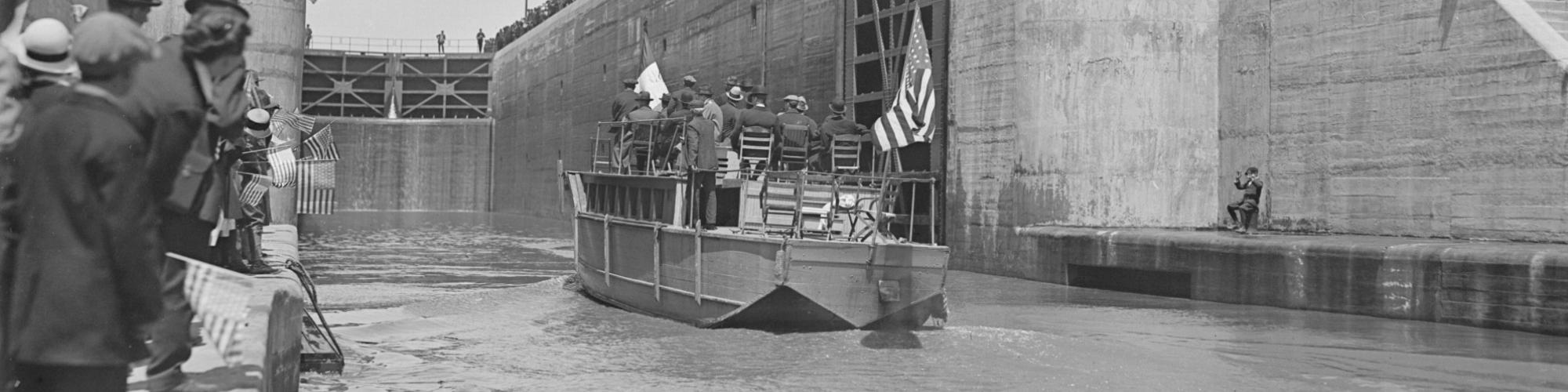
My areas of research revolve around the development of industry and transportation in the State of New York and how that development impacted the lives of New Yorkers. Currently, I am focusing on the New York State canal system as part of preparation for an exhibit on the Erie Canal that will open September 16, 2017. The exhibit, Enterprising Waters: New York’s Erie Canal (Phase One),  marks the 200th anniversary of the beginning of construction of the canal. As an offshoot of that work, I am also working on the story of the Waterford Flight of locks. The “Waterford Flight” as it is known, is a set of 5 locks located at the entrance to the New York State Barge Canal System. 2015 marked the 100th year that the National Civil Engineering Landmark has been in service. My focus has been on the impact on the community both physical and social from the construction to today.

Publications

2017

E. Landing, P.M. Myrow, G. Geyer, D. McIlroy 2017, Ediacaran– Cambrian of Avalonian Eastern Newfoundland (Avalon, Burin, and Bonavista Peninsulas)

2016

Joseph Meert, Natalia Levashova, Mikhail Bazhenov, E. Landing 2016, Rapid changes of magnetic Field polarity in the late Ediacaran: Linking the Cambrian evolutionary radiation and increased UV-B radiation, Gondwana Research 34, 149–157. 10.1016/j.gr.2016.01.001
E. Landing, G. Geyer 2016, Comment on “Terreneuvian Small Shelly Faunas of East Yunnan (South China) and Their Biostratigraphic Implications”, Palaeogeography, Palaeoclimatology, Palaeoecology , doi: 10.1016/j.palaeo.2016.04.016. 10.1016/j.palaeo.2016.04.016
Geyer, G., Landing, E., 2016. The Precambrian–Phanerozoic and Ediacaran–Cambrian Boundaries: A Historical Approach to a Dilemma, in: Brasier, A., McIlroy, D., McLoughlin, N. (Eds.), Earth System Evolution and Early Life: A Celebration of the Work of Martin Brasier. Geological Society of London, London, England, pp. 311-349.
E. Landing, A. Kouchinsky 2016, Correlation of the Cambrian Evolutionary Radiation: geochronology, evolutionary stasis of earliest Cambrian (Terreneuvian) small shelly fossil (SSF) taxa, and chronostratigraphic significance, Geological Magazine 153, 750-756. 10.1017/S0016756815001089
Judy Pu, Samuel Bowring, Jahandar Ramezani, Paul Myrow, Timothy Raub, E. Landing, Andrea Mills, Eben Hodgin, Francis Macdonald 2016, Dodging snowballs: Geochronology of the Gaskiers glaciation and the first appearance of the Ediacaran biota, Geology 44, 955-958. 10.1130/G38284.1
M. Webster, E. Landing 2016, Geological context, biostratigraphy and systematic revision of late early Cambrian olenelloid trilobites from the Parker and Monkton formations, northwestern Vermont, U.S.A., Australasian Palaeontological Memoirs 49, 193-240.

2015

E. Landing, J. Antcliffe, M. Brasier, A. English 2015, Distinguishing Earths Oldest Bryozoan (Pywackia, Late Cambrian) from Pennatulacean Octocorals (Mesozoic-Recent), Journal of Paleontology 89, 292-317. 10.1017/jpa.2014.26
E. Landing, G. Geyer, R. Buckwaldt, S. Bowring 2015, Geochronology of the Cambrian: A Precise Middle Cambrian U-Pb Zircon Date from the German Margin of West Gondwana, Geological Magazine 152, 28-40. 10.1017/S0016756814000119
E. Landing, A.W.A. Rushton, R.A. Fortey, S.A. Bowring 2015, Improved Geochronologic Accuracy and Precision for the ICS Chronostratigraphic Charts: Examples from the late Cambrian–Early Ordovician, Episodes 38, 154-161.